
Return to Kant?
Reflections on Marxist Readings of Kant and the Pitfalls of Neo-Kantianism

In the wake of the 1848 Revolution, Hegelian thought was profoundly unsettled. According to the well-trodden story that Engels tells towards the end of his life, reflecting back on the post-1848 period of the class struggle, Hegel left the university after 1848 and became a weapon for the proletariat. From the standpoint of the bourgeois academy, however, the broader premise of the Hegelian system was decisively refuted by the defeat of 1848. If history were truly moving toward the imminent realization of ideals and reason as the Hegelians promised, that promise collapsed in 1848, and by the time of the Restoration in the 1850s, the conditions for sustained Hegelian thought had totally fell apart. As the historian Frederick C. Beiser points out, many philosophers argued that Kant had more more to say in the wake of the failed 1848 revolution than Hegel. This political failure set the stage for the neo-Kantian revival that took off in the 1860s and 70s.
Are Kant and Hegel two vastly different philosophical tableaus, one of whom gives rise to a reactionary bourgeois philosophy (Kant), the other who belongs to the left (Hegel)? Lenin’s early 1909 text Materialism and Empiro-criticism disputes such a vulgar reading. While he does not completely reject Kant, Lenin instead shows how, since the time of Feuerbach and then Marx and Engels, a materialist, leftwing reading of Kant is possible: “when Kant assumes that something outside us, a thing-in-itself, corresponds to our ideas, he is a materialist. When he declares this thing-in-itself to be unknowable, transcendental, other-sided, he is an idealist.”1
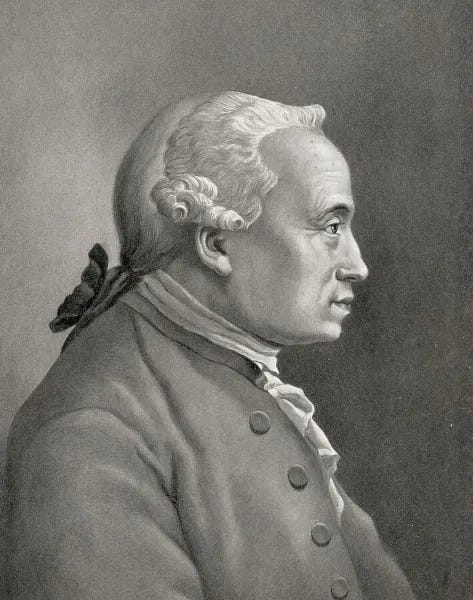
Marxist Readings of Kant and the Pitfalls of Neo-Kantianism
Marxist and socialist readings of Kant tend to be highly cautionary given that a full absorption of Kant has so often resulted in distinct problems that negatively affect the class struggle. Chief among these is the problem of political epistemology—and indeed of political belief—namely that the Kantian doctrine of the unknowable thing in itself leads to what Engels points out in Anti-Dühring as the problem of agnosticism. In The Destruction of Reason Lukács develops a theory of irrationalism that is centered on a wider thesis that irrationalist philosophy has its origin in a perversion of the Kantian unknowable (noumenon), i.e., when the philosopher elevates intuition, myth, or vitalism to replace the more rationally developed thought of Hegelian and Kantian philosophy. Lukács provides a systematic study of the various forms of irrationalist thinking which I discuss in this article, and he identifies the core problem of this perversion of Kant as problematic for socialists in the way that Kant obscures social antagonisms and thus fails to assist workers in grasping social reality.
In fact, the very question of the knowability of social reality becomes the locus of practical concern for the socialist movement, and one of the most lucid accounts of how Kantian thought harmed the worker’s movement is found in the writings of Labriola, the Italian Marxist teacher. Labriola pinpoints how the Kantian-inclined Marxist intellectuals tended to posit a division between economic conditions and mental reflections — they interpreted thought to be a matter of interpreting stenographic signs. He wrote that for these Kantian Marxists, the embrace of the fundamentally “unknowable” led to quietism and stupidity. The embrace of Kant led the proletarian movement to fall sway to bourgeois ideology, i.e., it led the worker’s movement to accept the impending ruin of capitalism and to retreat from the gravity of the breakdown of the system. It is in this way that Kantianism leads to reformism. Labriola calls the adoption of Kantianism “a sort of religion of imbecility.”2 Labriola draws a similar conclusion that Lukács develops, namely that the adoption of Kantian thought leads to an uncritical alignment with bourgeois thought insofar as bourgeois thought cannot think anything except experience. Put differently, Kant does not offer an epistemology in which fetishism can be interrogated and overcome.
At best, the Kantian system of concepts and doctrines, when applied to concrete problems of social and political life produces a reformist and ethical version of socialism. In this regard it is telling that the final chapter of Evolutionary Socialism by Eduard Bernstein is entitled “Back to Kant” as Bernstein was arguing for a return to Kant as a philosophical move that would set socialism on a clear path. This premise, as I will develop below, is shared by Marxists. But the reformist social democrat Bernstein was not advocating a return to Kant, as he writes:
“If I did not fear that what I write should be misunderstood (I am, of course, prepared for its being misconstrued), I would translate Back to Kant by Back to Lange. For, just as the philosophers and investigators who stand by that motto are not concerned with going back to the letter of what the Königsberg philosopher wrote, but are only concerned with the fundamental principles of his criticism, so social democracy would just as little think of going back to all the social-political views of Frederick Albert Lange.”3
Bernstein’s confession that his return to Kant was in reality a return to Lange, not Kant, reveals the problem of neo-Kantianism. It is telling given that Lange’s materialism was far from Marx’s own materialism. In fact, Engels clarified in a letter to Lange that his materialism diverged from Marx in that Lange posited a universal law of the struggle for survival as what explains every event, when in reality “none of these laws, insofar as it is an expression of purely bourgeois relations, is older than modern bourgeois society.”
At issue is the capacity for the proletariat to come to know its time in thought (the Hegelian task). The adoption of Kantian thought only compounds this incapacity to know the inner workings of the social order — but Kant is not the reason for this incapacity, this incapacity would exist without him given that it is a fetishistic feature of bourgeois thought as such. This conundrum between Kantianism as a class ideology and class ideology as such is addressed in an interesting new article, Killer Kant? The role of Kantian philosophy in the decline of socialism by Martin Küpper.
If Kant spells the demise of Marxism, was Kant’s presence in intellectual life in the G.D.R. East German communist society following the downfall of Stalin a major cause for the collapse of communism? In some ways the question is posed in a highly reductive and vulgar fashion, but if we mean by Kantianism ‘middle class socialism,’ the question becomes more valuable. If the Kantian problem is endemic to the worldview of the middle class as such, Marxist philosophy cannot escape its defining feature as proletarian-directed thought and practice.
Küpper shows that the early Soviet system relied on a working class path to rapid industrialization, agricultural collectivization, a weakening of the power of property owners, and a stronger role for the Communist Party, especially in economic planning. In contrast, when a more gradualist perspective, associated with the petty bourgeoisie emerges in the wake of Khrushchev we witness the integration of capitalism, private property, market competition, and profit incentives, into the socialist transition. Khrushchev did not need Kant to justify this transition to capitalist reforms, it was the practical steering of the political progress of the country towards the class interests of the middle class that spelled the undoing of the system. In this sense it is hard not to agree with Labriola that the triumph of the proletariat is the only means we have to secure the scientific conditions of collective existence.
Where Kant Belongs (in Marxism)
What does it mean to return to Kant in such a way that we do not re-affirm neo-Kantian tendencies or reformist ethical socialism? A series of answers to this conundrum are provided by some of the main founders of western Marxism. In Marxism and Philosophy, Korsch identifies four main historical sequences of Marxism: the revolutionary movement of the bourgeoisie, idealist philosophy from Kant to Hegel, the revolutionary class movement of the proletariat, and the materialist philosophy of Marxism, and he sees these as four moments of a single historical process.4 What is implied here is that Kant is the starting point of Marxism even though Hegel surpasses Kant in terms of the system he develops.
A similar claim is made by the east German Marxist thinker Wolfgang Harich who argued that Kant was on the trail of dialectical laws in the sense of Marxist ontology and views of nature, especially in the sense of the doctrine of the struggle of opposites.5 Ernst Bloch pointed out in a 1954 article, “Zweierlei Kant-Gedenkjahre” that Kant’s categorical imperative is “unfollowable” in capitalist class society as it obscures the contradictions between social classes. In Bloch’s point of view, the categorical imperative tends to function more as an anticipatory formula for a non-antagonistic, classless society, where true moral generality can thrive. This does not imply that Kant is a socialist, it indicates that he is a fundamental founder of the socialist heritage.
Perhaps the most ambitious and far-reaching re-casting of Kant in the light of Marxism is found in Lucien Goldmann’s 1949 work Immanuel Kant which re-situates the legacy of Kant not in a lineage that initiates German idealism, but in a far wider Augustinian historical arc beginning in the 17th century. Goldmann argues that Kant emerges as a philosopher that unites the Christian idea of the limitation of man with the immanence of the ancients and the philosophers of the seventeenth and eighteenth centuries in considering the intelligible world, the totality, as a human task, as the object of the authentic destiny of man and the product of human action.
Whilst the classical philosophers, starting out from the individual, had been centrally concerned with epistemology (rationalist or empiricist) and ethics (Stoic or Epicurean), and Christian thinkers, starting out from God, had made theology the basis of their systems, Kant for the first time created the possibility of a philosophy based on the idea of the community and the human person, that is to say, on the philosophy of history.6
In his later, untranslated work Paths to Praxis, Michel Clouscard argues that both Edmund Husserl and Claude Lévi-Strauss inaugurate distinct variations of neo-Kantianism.7 In doing so, he contends, their philosophies succumb to the central limitation of neo-Kantian thought: they ultimately become indistinguishable from the dominant ideology of liberalism. While I will not summarize Clouscard’s argument in detail here, what is most valuable about his theory of neo-Kantianism is that he argues the central refusal of neo-Kantianism is the category of social ontology and the fulfillment of the production process.
Building off of the later work of Lukács, Clouscard argues that it is social ontology that is most distinctive in Hegelian-Marxism and it is social ontology that all variations of Kantian thought cannot address adequately. Phenomenology and structuralism are exemplary of neo-Kantianism in that they both propose what he calls a “Yalta of the concept” by which he means that they divide reality at the level of thought itself into two separate “zones”: pure subjectivity (intentional consciousness, meaning, lived experience) and objective reality (history, society, political economy). This partition of reality is undialectical and is premised on the refusal of praxis, which means that it cannot touch on social being in any way that would interrogate into the production process itself.
Kantian-Marxism and Its Limits: Kojin Karatani

More recently, the Japanese philosopher Kojin Karatani has developed a sophisticated “parallax” reading of Kant and Marx that aligns the Kantian ethical system with an immanent critique of commodity exchange as Marx develops in Capital. In Karatani’s system, Kant’s ethical reflections are not ahistorical or immaterial but point to a universal dimension. As Bloch suggested, Kant’s ethics cannot be realized in just any given social arrangement. Karatani takes this premise to the farthest extent than has ever been done in this history of Marxism. Indeed, Karatani shows that even for Kant himself, the commodity exchange that dominated in his time – merchant capitalism – had to be transcended as a precondition for any enactment of Kantian ethics. Kant’s ethics are thus co-thinkable not only with Marx’s critique of commodity fetishism and capitalism, but the Kantian ethical theory informs Marx’s praxis, offering a utopian account of world revolution.
What I find most interesting in Karatani’s ambitious attempt to develop a Kantian-Marxism is that while he reproduces many of the hallmark tendencies towards revisionist Bernsteinian practice — most notably he advocates a practice of associationism in which class struggle is waged on the site of the market through boycotts and consumerist struggle — he insists that his practice is revolutionary, not reformist. His rationale for this revolutionary practice, which I have developed in an essay on Karatani and psychoanalysis, is based on a series of tactics and political organizing strategies aimed at dissolving both the state and capital.
In what follows I want to outline a critique of Karatani’s method of “associationism” which identifies how his Kantian-Marxist project theorizes an ethical socialism that still retains a revolutionary practice. My main objection to Karatani, while fully acknowledging his brilliance and originality, is that he narrows the terrain of struggle to the market and thereby participates in the post-Marxist trend that we see in the Frankfurt School, namely the objective of class emancipation is totally obscured in his practice. This is due to Karatani’s refusal to focus agitation at the site of production, a decision he makes for Kantian ethical reasons.
Can Associationism Replace Historical Materialism? Rethinking Kojin Karatani
Karatani critiques historical materialism and Marxist-Leninist theories of praxis by arguing that a major flaw in this wider field of theory (broadly known as historical materialism) is that its praxis led to conceptions of the state and the nation as intrinsic parts of the superstructure of society, on par with art or philosophy. These revolutionary socialist movements, including Marxist-Leninism, notionally sought a form of socialism beyond the nation-state form. However, they could not dissolve the nation or state as distinct categories of social life because both are inextricably bound up in modes of exchange.8
In Marxist theory, particularly historical materialism, revolutionary praxis is set on seizing the means of production of capitalist society, or what Marx called the “base” structures of capitalist society (i.e., industry, labour, and other centers of production). Karatani argues, on the contrary, that the failures of 20th-century Marxism, specifically the communist revolutions in Russia, China, and elsewhere, were due to general neglect of thinking revolution at the level of the modes of exchange. Once these 20th-century movements seized the means of production, transforming the superstructure – the wider spheres of culture and education – was the primary task. The nation and the state were predicted to wither through enlightening the people. However, as we know, these movements never adequately transformed the nation or the state – and it was in these domains that the most profound violence and upheaval occurred.
In the post-Bolshevik revolution period (1917–1940s), as in the Chinese Cultural Revolution (1966–1976), the task of the ongoing revolution or the “permanent revolution” was set on overcoming the imaginary structures of nation and state to drive towards a communist arrangement of society. This task called for enlightenment, that is, the proper education of the masses (Maoism), the cultivation of a trained vanguard (Leninism), and so on. However, this task left untouched, or did not privilege, revolutionizing the modes of exchange. So the modes of exchange largely remained tethered to forms of commodity exchange and were held within the purview of capitalist modes of exchange, albeit with a planned and centralized/nationalized economy. In other words, the praxis Karatani prioritizes revolutionizing modes of commodity exchange to forms of reciprocal gift exchange.
In Karatani’s critique, 20th-century Marxism falsely saw the state (egalitarianism) and national (fraternity) spheres as superstructural extensions of society and thus saw these spheres as fundamentally rooted in the base mode of production. As such, they were theorized to wither through programs of education. But thinking these categories as superstructural effects failed to adequately link the project of superstructure struggles, what we might call representational struggles – such as education of the masses, the promotion of revolutionary art and culture – to base struggles (or struggles of production and labour). Karatani argues that this occurred because they neglected the modes of exchange inherent in the state form – and exchange being the core component of the base. Thus, what occurred in 20th-century socialist movements of state communism, as we know full well, was that capital ended up holding hegemony over social relations within the nation and the state – that is, commodity exchange eventually overwhelmed all three spheres. Perhaps there is no better evidence of this than contemporary Chinese communism, which has fully adapted to capitalist modes of exchange, and the degree to which the national sphere remains tied to a communist zeitgeist is mostly in mythical and cultural forms.
Karatani’s critique points to the broader premise of historical materialism – that the modes of production are the primary site of revolutionary struggle – not being a thesis that bears the weight of recent history. Against this conception, Karatani argues that the state and nation should be understood as extensions of the base – namely, as extensions of dominant modes of exchange. What might a praxis that emphasises the modes of exchange over that of production look like? In answering this question, it is first important to ask whether there is effective resistance to capital at the level of the mode of production because if you take the governing hegemony of mode C seriously, you will understand that its proliferation extends to all areas of social reproductive life as well as the industrial labour process. Therefore, resistance within the circulation sphere is a preferred site to wage struggle because the subject resisting in this ubiquitous sphere holds a higher potential to resist as a free subject. They may be less encumbered, for example, by superegoic constructions that might plague a worker in a corporation or factory who must deal with bosses. Resistance to mode C at the productive level still maintains the edifice of capital valuation, and no resistance is possible if we limit ourselves to thinking resistance to the production process alone; as Marxists, it is necessary to grasp capital as a totality. Karatani observes, “if workers decide to resist capital, they should do so not from the site where this is difficult but rather from the site where they enjoy a dominant position vis à vis capital.”
Resistance at the exchange site is the optimal form of resistance to the dominance of capital and proletarians can only create a universal subject that is revolutionary when exchange-based struggles are prioritized. The Kantian reading now becomes clear: because capital forces us to work but not to buy and as such consumer struggles retain a degree of autonomous freedom of the individual. Karatani sees the advantage of exchange-based struggles to emerge from the way that they enable resistance to capitalism to not arbitrarily separate other struggles from working-class struggles.
But he takes this further and argues that circulation struggles also offer an opportunity to create new currencies and credit systems. The primary tactic in these struggles is the boycott which has a specific advantage – it is legal. Boycotts typically take two forms: refusal to buy and sell, and for the method of the boycott to work, an alternative economy must exist. Tactically, this includes the boycott within consumer capitalism, but the boycott Karatani envisions takes the role of refusing to sell and to buy. To compel people in this direction, noncapitalist alternative consumer economies must be created. In a more refined level of organization, in which forms of state power might open for proletarian takeover, there is also a central international dimension to associationist praxis. This dimension drives towards a new world system of states centered around reciprocal gift exchange, using tactics such as voluntary disarmament of weapons, free exchange of production technology, and abolishing intellectual property restrictions. What would an international alliance formed around the gift look like across nation-states? Perhaps things such as mutual disarmament plans and sharing technology across nations would function as gifts that might eventually challenge the hegemony of the real bases of capital and nation.
There are immediate challenges that the associationist praxis opens: questions of scalability – how can methods of boycott compel large swaths of the population to take on anticapitalist agitation, especially when the predominance of liberal modes of political critique leaves the deleterious effects of commodity exchange unexamined? Does there not need to be a prior consciousness-raising movement against capital at the site where people are least free, precisely in the sphere of labour? Further, perhaps most surprising in the associationist theory of praxis is how it foregoes the period in a revolutionary sequence, identified by Marx as the “dictatorship of the proletariat,” or the stage in which the proletariat seizes state power directly. Perhaps the question of power seizing, and the inevitable violence that comes with it, is not theorized as a necessary sequence of revolutionary struggle due to Karatani’s emphasis on modes of exchange over that of the political as a distinct or separate sphere of social life.
At the same time as these critiques of associationism are real and compelling, there are other benefits to the associationist praxis for Marxist struggles today. For example, associationism can be thought to align with existing theories of communization and insurrectionary struggles. The movements that opened with the anti-WTO protests in the early 1990s in Seattle, known broadly as the “anti-globalization” struggles, up to the Occupy movement and Black Lives Matter – all deploy the tactics of what Joshua Clover refers to as “circulation struggles.” These insurrections seek property destruction and stoppages to circulating goods and commodities and are thus aiming to halt the ease of circulation globally. While these circulation struggle tactics of revolt align with a shared goal of disrupting the dominance of mode C, it is not clear that these tactics are proactive in forging an alternative mode of exchange through communal alternatives to currency exchange, the introduction of gift economies based on reciprocity, etc.
Lenin. Materialism and Empirio-Criticism: Critical Comments on a Reactionary Philosophy, “The Philosophical Idealists as Comrades-In-Arms and Successors of Empirio-Criticism”
Labriola, Antonio. Socialism and Philosophy. 1897. p. 94
Bernstein, Eduard. Evolutionary Socialism. 1909. p. 192.
Korsch, Karl Marxism and Philosophy. 1923. p. 45
Goldmann, Lucien. Immanuel Kant. 1945.
Clouscard, Michel. Les chemins de la praxis : fondements ontologiques du marxisme. Paris : Éditions Delga, 2015.
These concluding remarks on Karatani are an excerpt from my essay: Daniel Tutt, “Karatani for Libidinal Economy: Invariance and Praxis,” in Libidinal Economies of Crisis Times: The Psychic Life of Contemporary Capitalism, ed. Ben Gook (Bielefeld, Germany: Transcript Verlag, 2024), 217–42, https://doi.org/10.1515/9783839456859‑011.
Appreciate this — the neo-Kantian pitfall is real and I think it maps onto something happening in DSA politics right now more directly than it might seem. The centrist tendency's framework is essentially neo-Kantian in structure: universal moral imperatives (nonviolence, broad coalitions, "not alienating people") deployed as regulative ideals that end up disciplining the left rather than confronting capital. The Kantian move is always to legislate the conditions of legitimate action *before* the action occurs, which in practice means the action never occurs on terms that threaten anything.
Curious whether you see Karatani's Mode D as a way out of this or just a more sophisticated version of the same trap. The question I keep coming back to is whether any theoretical framework that begins from the normative can produce a politics adequate to a moment where the state is prosecuting printers and zine distributors as terrorists.
Super interesting