
The Ecumenical Marxist
How Fredric Jameson Reconstructed Totality After Structuralism

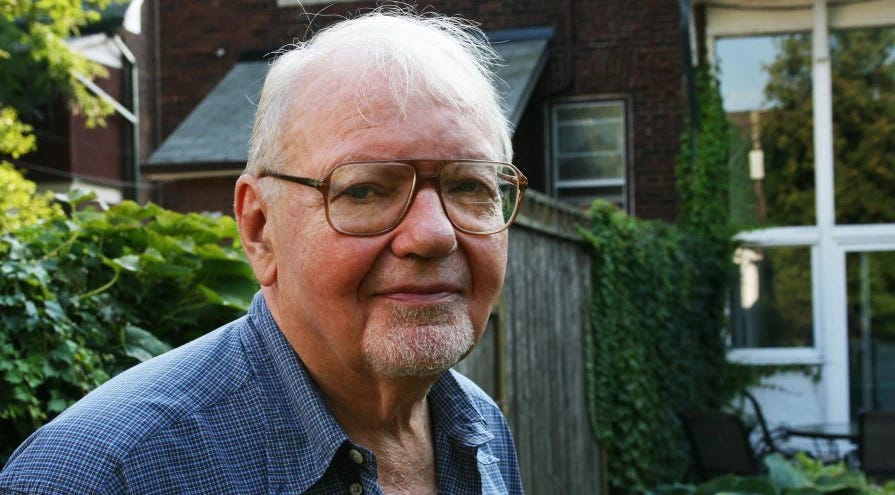
It is hard to believe that it has already been two years since Fredric Jameson passed away. I marked the occasion by hosting a study group on his masterpiece The Political Unconscious, a text which I want to talk about and which I think stands as Jameson’s most important intervention. I never met Jameson in-person and I never got the chance to take a seminar with him, although in the last months of his life I had introduced him via email correspondence to the work of the French Marxist Michel Clouscard and the Clouscard circle in France had mailed Jameson a package of his main works. Just a few months after we sent him Clouscard’s work, to which Jameson responded with great interest and curiosity, I learned that Jameson had passed away.
It should never be minimized that Jameson rose to prominence during a time of profound political and cultural transformation and that his rise in the academy was shaped by the anti-communism of the Cold War. To work openly as a Marxist within the academy during this time meant accepting professional isolation and this led the vast majority of left academics to conform to the fads of an increasingly liberalized Marxism. Jameson was, at least judged by his practical commitments, a New Left Marxist. He was not bound to any communist party, he was largely critical of the Soviet Union, and he practiced a striking ecumenical method in his work, defined by a tendency to incorporate and subsume discourses that seem to have no reason to come into harmony or synthesis with Marxist methods.
In this piece, I want to argue that it would be a vulgar deduction to say that due to his New Left practice Jameson’s Marxist commitments were liberal or merely academic. I will argue here that once we follow the role that Jameson carved out for Marxism in the wider critical humanities—a field of study that he most definitely defined and dignified with a total rigor and Marxist commitment—we will see that his project rightly deserves the attention of Marxists, especially the admiration of those Marxists (I include myself here) who find academic Marxism to at best serve as a sanitizing version of Marxism, or at worst as an irrationalist obfuscation of Marxism.
After all, we should note that Jameson’s Marxism was serious enough to cause the science fiction novelist Philip K. Dick to report him to the FBI. Dick’s paranoia was driven by his fear that communist critics and writers like Jameson would come to dominate all opinion about science fiction, which is actually quite hilarious in retrospect because it can be analyzed along a Jamesonian line as a breakdown in what he coined as ‘cognitive mapping.’ Jameson’s concept of cognitive mapping refers to the way that capitalist society has fragmented and parcelized to such an extent that the Lukácsian aim of literature and aesthetics as an attempt to grasp the totality has become increasingly impossible. Jameson’s theory of cognitive mapping thus serves, as many of his concepts do, a double function: it initially describes the limits of literature and art to capture relations of the totality, but its a concept that stretches beyond textual or merely academic concerns. The decline in cognitive mapping helps us understand why conspiracy theories have become so common in late capitalism. The proliferation of conspiracy thought is a compensatory phenomenon, a reaction to the decline in the capacity for people to know the social totality in which they live. But isn’t this something like a paradox given that globalization would seem to produce a highly interconnected social order in which multinational corporations, in eroding nation-state sovereignties and opening and unifying markets, might make the world more homogenous?
Roberto Calasso, in his exquisite work The Unnameable Present, gets at the problem of cognitive mapping in a long meditation on tourism and travel in the present. He offers a particularly useful formulation to describe the unnameable present, namely that ‘society’ has become what god is to his worshippers.1 Calasso’s unnamable present is closely related to the decline in cognitive mapping in that he argues more and more our experiences are registered as completely outside of our cognition; no longer do our experiences of the world occur inside via consciousness, a process which is discrete and continuous. He locates this in a shift towards globalization in ways similar to Jameson’s theory of cognitive mapping, and he argues that in the 20th century, social control was about control over the past and the future whereas now, in the 21st century, control is over the present. Calasso sees the process of social control as centered on the manipulation of data wherein the state is no longer the sole force intervening to manage social control. We no longer experience events as discrete instances in which we can locate causality. A proper Jamesonian response to the unnameable present and the problem of cognitive mapping would be to historicize its emergence in our culture, to trace the contradictory relation between the forces and relations of production that brought this intense fragmentation about. The Political Unconscious (1981) offers a means to get at this.
The Ecumenical Marxist and the Method of Fredric Jameson
I first encountered Jameson through The Political Unconscious. I found it one summer afternoon after working landscaping. About twenty pages into the book I began to realize that the sheer density of Jameson’s references were beyond what I had the capacity to fully appreciate at the time. So I began to draw up a bibliography of what it would take to be on level (equality is here too relative) with this monumental text. At that time I was only about 20 years old so there was no way I could have gained a grasp on the main contours and points of primary influence. We can identify what one needs in order to have a reading relationship with Jameson’s masterwork that is close to equal to the ambition of the author (and this list may indeed, arguably, have additional lineages of thought I have not included): Lukács’s theories of realism in literature, his reading of Hegel and Marx and most especially his concept of reification from History and Class Consciousness; Althusser’s critique of historicism and historical causality from For Marx and Reading Capital; the structuralist and the post-structuralist Nietzschean turn in French thought, Barthes, Derrida, Deleuze, Foucault and Saussure’s concept of structural linguistics; a solid grasp on Lacanian psychoanalysis; Sartre’s Marxist turn in The Critique of Dialectical Reason; Northrop Frye’s theory of literary genres; Ernst Bloch’s conception of utopia and theory of ideology and the main currents in twentieth century Marxism more generally.
If you thought this was it, of course you would be wrong given that the book is about how to understand the hermeneutics of literature. As such, in order to fully grasp The Political Unconscious you should also be familiar with the main literary canon of European realism: Balzac, Flaubert, Stendhal, Scott and modernist authors from Proust to Joyce, most especially Conrad and Gissing. These are the prerequisites that I did not have when I first encountered the book some 20 years ago. Reading the book last year and offering a series of lectures and guided discussion on it was deeply rewarding precisely because I had finally reached a place where I had worked though the prerequisites. I finally read Jameson on what felt like a level playing field.
At the outset of this essay, I made the argument that Jameson’s Marxism is singular and distinct and we get an indication of this in the first few pages of the Preface to the book where he states that Marxist methods are the “untranscendable horizon” that “subsumes such apparently antagonistic or incommensurable critical operations, assigning them an undoubted sectoral validity within itself, and thus at once canceling and preserving them.”2 Here we find the heart of the ecumenical method, one that is open to seemingly antagonistic forms of social critique whereby Marxism is that system that leads the way by consuming and processing (canceling and preserving) all rivals. This approach resembles the commitment to the Marxist method that Jameson no doubt learned from his first real master Jean-Paul Sartre who argued that Marxism remains the unsurpassable system of thought that cannot be transcended. At a time when most Anglo-American academics were more seduced by Foucault’s suggestion that Marxism is like a fish out of water when it leaves the 19th century.
A Solution to the Problem of Mechanistic & Individualist Historical Causality
The sheer density and novelty of The Political Unconscious means that it can be picked apart in numerous ways, from the original reading of Conrad as a pivotal figure of modernism who allows Jameson to develop a series of interesting concepts to describe how Conrad depicts a society increasingly overwrought by imperialism and how this affects the capacity for the author to describe or give meaning to the total situation of an imperialist world system. Or one could focus on Jameson’s reading of realism and the end of realism.
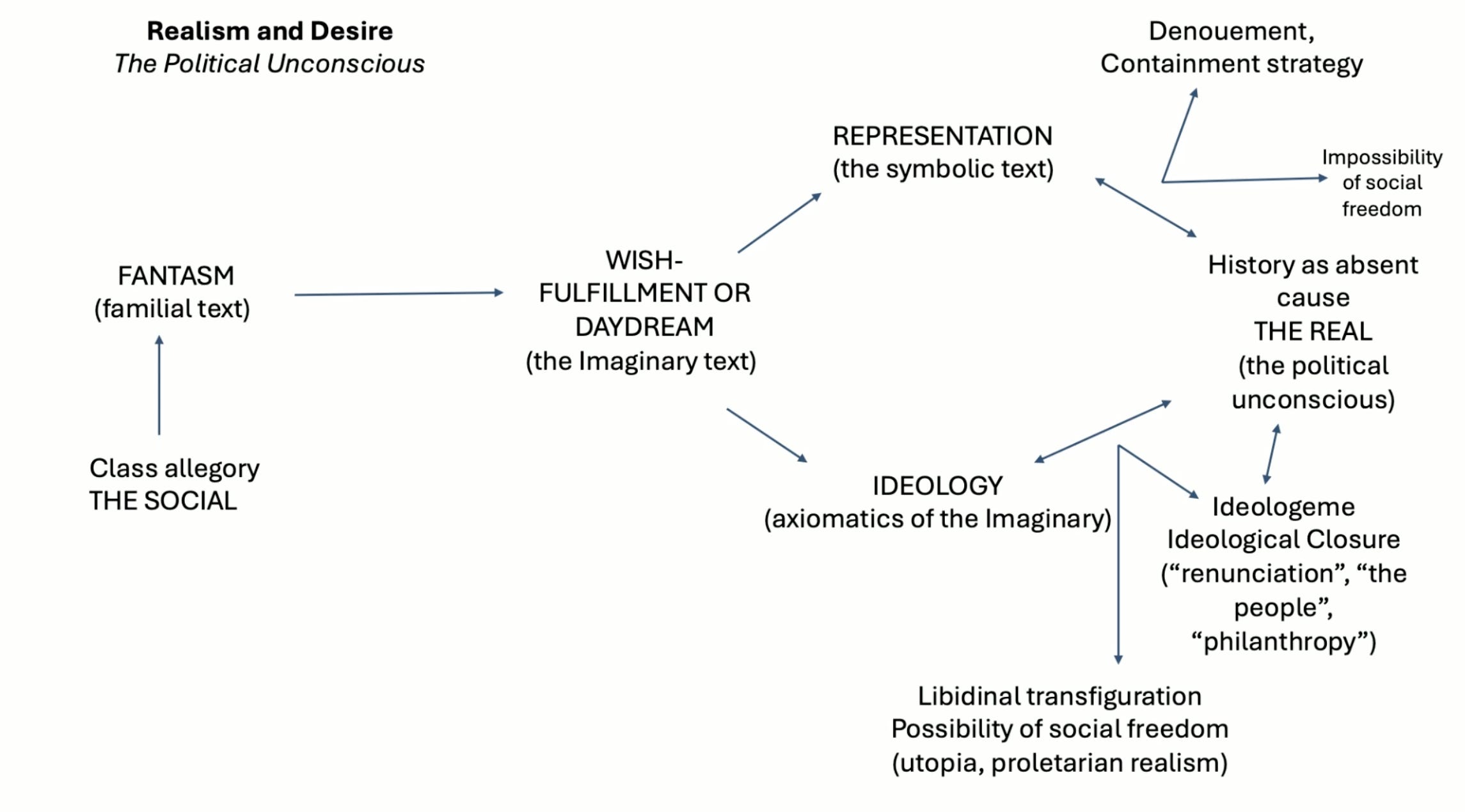
If I were to hit on Jameson core problem in The Political Unconscious I would characterize it like this: late capitalism has reified realism and thereby caused romance as a genre to once again come to the fore because narrative is now heterogeneous: freedom is untethered from the reality principle, the reality principle is now oppressive, realistic representation is in a ‘hostage situation.’ The whole of the social cannot be grasped from the cause of a given structure as that would fall into the error of mechanistic causality, in which the truth of the world accords to a deeper more fundamental narrative. Once we assume this form of meaning we have to account for how this form of historical causality in which the ‘political’ appears in a given text. The political, in the wake of Freud and Lacan, is what is repressed from the text, i.e., it is what is hidden in the text. Related to this problem of arriving at the political, Jameson asks how can we arrive at a higher meaning of the text in light of French theorists from Derrida, Foucault, Baudrillard etc. who have formulated an anti-dialectical method opposed to meaning and interpretation. Jameson argues for a reinvigorated method of literary analysis that does not nullify all meaning, as the post-structuralists insist, but one that demands a new “anti-transcendent hermeneutic” model. The task of the book is thus to discover this anti-transcendent hermeneutic, one that will restore the surface to the text while not forfeiting our commitments to history and to meaning.
Now if that was too compact, let’s analyze how Jameson gets at the problem of historical causality in order to show how his ecumenical method works. We must start with two terms: the social and the historical before we arrive at the political. The ‘social’ is defined by Jameson as the diachronic struggle between social classes as they appear in the context of the text; the ‘historical’ is the sequence of modes of production and social formations, and thus the historical opens the problem of causality and how we understand the ‘whole’ or the ‘totality’ of society, indeed, the historical poses a meta problem of meaning. If we locate the historical truth of the social world of a given text, say the realist novel The Red and the Black by Stendhal or Balzac’s Lost Illusions, something of the ‘historical’ is shown to us in these texts in that there is a unity between the social (the class antagonisms of the characters) and the historical (how class relations are determined by and shaped by the social formations and modes of production in which the novel transpires). But this does not offer up an immediately clear answer as to what the ‘political’ is.
Herein lies Jameson’s move to incorporate Althusser’s famous distinction between three forms of causality which helps us arrive at the proper means to understand the meaning of a given text. The first form of causality is mechanistic causality wherein the parts can simply be deduced from an external cause. The classic example is the base and superstructure model in which culture merely reflects changes in the economic base. Importantly, Jameson never dismisses mechanistic causality entirely because there are situations where changes in political economy alter literary production in direct ways. The commercialization of publishing, for example, transforms what kinds of novels become possible.
The second model is what he calls ‘expressive causality’ which is inherited from Hegel. Here every particular expresses an underlying essence. Every literary character, institution, or historical event becomes an expression of the whole. Lukács’ theory of realism often moves in this direction in that the literary character becomes a social type and the novel itself works as an allegory of society. History becomes legible because each part reflects the totality from which it emerges. Lucien Goldmann’s conception of class worldview in The Hidden God is critiqued by Jameson, wrongly I would say, as an example of an expressive causality in that the class being of the proletariat and the bourgeoisie are determined by homology to an inner essence and not by mediation. This may be the one area of the text in which I find Jameson’s reading of expressive causality as flawed because I think he misses the logic of Goldmann’s genetic structuralism. But putting that to the side for now, what expressive causality posits is that the individual is capable of expressing the logic of the whole, i.e., that the whole is reducible to an inner essence. Herein lies the problem for Jameson with expressive causality, it posits a hidden deeper narrative, and this means that it relies on allegory as the underlying, more fundamental narrative. This leads to providential history as we find in some Hegelian readings of history, and it produces a teleology of history in which certain essential parts are posited as un-transcendable.
Jameson’s Impossible Synthesis
The shortcomings in expressive causality are made up for in Althusser’s theory of structural causality, the third form of historical causality after mechanistic and expressive. It posits that there is no hidden essence standing behind appearances waiting to be discovered. Society possesses no secret center from which everything radiates. All causes are therefore absent, or put differently, causes only exist only through the relations they organize. For Althusser, this destroys every attempt to read history as an allegory. Jameson accepts this critique but he refuses to abandon Lukács. This is the remarkable ecumenical move that he makes; rather than choosing between expressive and structural causality, Jameson asks how mediation itself might survive after Althusser’s critique. Structural causality still requires mediation because every social phenomenon must be translated across multiple levels of determination. Family life cannot be explained solely through psychology and nor can it be reduced to economics. The family exists at the intersection of institutions, class relations, ideology, sexuality, law, and countless other determinations. As such, no single phenomenon expresses some hidden social essence. Yet no phenomenon exists independently either.
The result is a synthesis of Hegelian expressivism with Althusserian formalism. It is a theory of historical mediation capable of preserving the Marxist ambition to think society as a whole without imagining that whole as an underlying substance. This leads us directly to Jameson’s conception of totality. If Lukács famously argued that the decisive difference between Marxism and bourgeois thought lies not in the priority of economics but in the standpoint of totality, critics too often assume totality refers to a completed system in which every contradiction is finally resolved. Others imagine that it names some authoritarian philosophical impulse to reduce diversity to unity.
Jameson rejects both interpretations. Drawing heavily upon Sartre’s Critique of Dialectical Reason, he insists that totalization is an activity rather than an accomplished fact. Totality is never present before us as an object. It exists only as an unfinished movement of thought. The totality is not an organic unity in which every part harmoniously expresses a central essence, and nor is it a mechanical system composed of isolated pieces. Jameson instead describes totality as produced through acts of interpretation that continually attempt to reconstruct the relations among otherwise fragmented experiences.
This is why The Political Unconscious remains such a remarkable book, precisely in the way that Jameson rescues totality from both its defenders and its critics. He does this both against and with the resource of post-structuralism. What Jameson shows is that in every refusal of totalization, another totalization is produced, i.e., even the celebration of fragments requires an image of the social whole against which fragmentation becomes meaningful. The irony of postmodernism of course is that in rejecting master narratives, that rejection becomes its own master narrative.
Against mechanistic Marxism, however, Jameson insists that totality itself can never become an object of direct representation. Every attempt to produce an organic image of society ultimately risks becoming ideological, and this is why the Althusserian ‘symptomatic reading’ remains indispensable because every apparent unity conceals what it excludes. The dialectic therefore becomes a continual movement between totalization and symptom.
Jameson’s deepest debt is to both Lukács and Althusser. He refuses the choice between historical totality and structural determination and instead he transforms each through the other. Our intellectual culture rewards specialization and theoretical camps. We inherit traditions by defending them against rival traditions. Jameson inherited traditions by forcing them into an ecumenical conversation that situated Marxism as the final word at the end of the movement of critique. His method was never reconciliation for its own sake. It was the conviction that capitalism itself is too complex to be grasped from a single theoretical perspective.
That is what made him an ecumenical Marxist.
My discussion on How to Read Fredric Jameson with literary scholar Robert Tally:
Roberto Calasso, The Unnamable Present, trans. Richard Dixon (New York: Farrar, Straus and Giroux, 2019), 22.
Fredric Jameson, The Political Unconscious: Narrative as a Socially Symbolic Act (Ithaca, NY: Cornell University Press, 1981), 10.
Really good and insightful!
That book shaped my art historical work when I was a grad student in nyc beginning in the early 1980s. Thank you so much for these commentaries.