

For those outside of academia, the Jason Arday tragedy only reinforces the parochial, petty and frivolous state of the institution. While it seems likely that Jason Arday was indeed guilty of plagiarizing the literature review portion of his dissertation and potentially falsifying research studies, the media ran with these accusations and expanded them into an all-out assault on his entire career, portraying him as completely fraudulent, full stop. The UK media is a vicious beast, and many of its practices are taken out of the old yellow journalism playbook, with inflammatory headlines driven by exaggeration and hype. Jason Arday became a scapegoat for a broken and radically unequal academic system, pure and simple. That Arday is a black man made this process all the easier to parade him about as the embodiment of a deep crisis facing the university, he was a scapegoat for a set of contradictions that far exceed him.
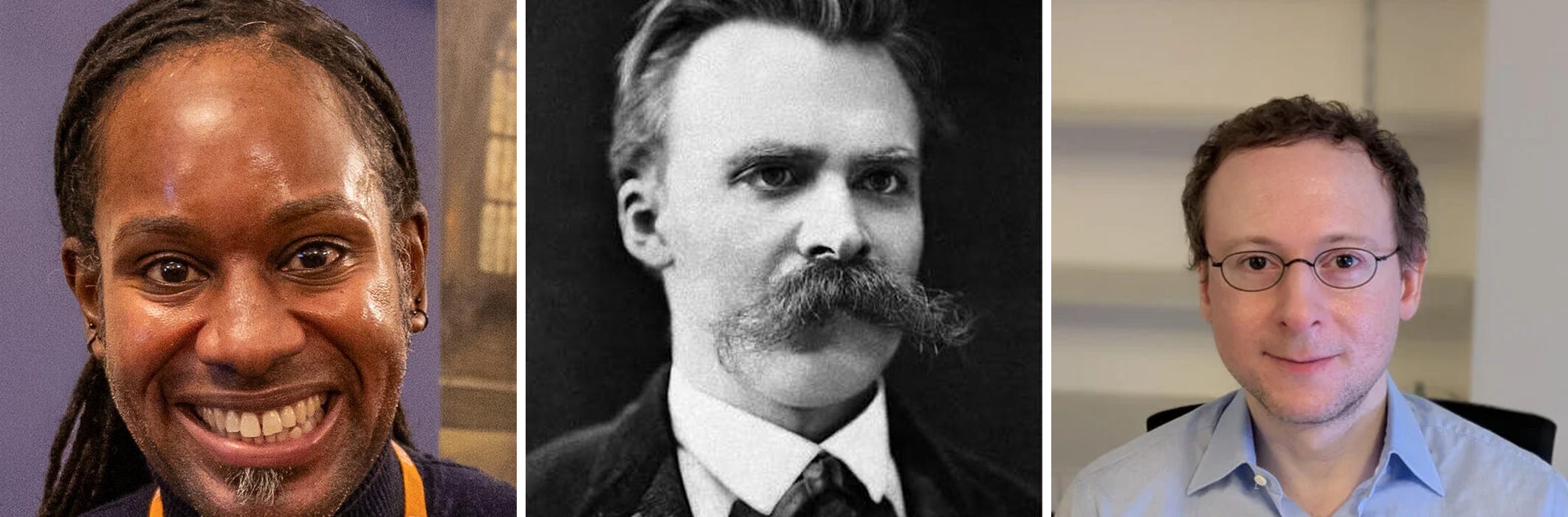
The man responsible for initiating this campaign of smears against Arday that led him to commit suicide is named Nathan Cofnas, an academic who refers to himself on X as a ‘philosopher of biology.’ He harbors extreme racialist views. He believes that black people are inferior to whites based on IQ. In recent interviews, Cofnas admitted that he was motivated to be a ‘whistleblower’ over Arday’s plagiarism because he was resentful over not receiving a prestigious job at Cambridge. Cofnas’s ideology must be situated in the wider orbit of today’s far right. This means that the Arday case was not only pumped organically by the UK media, it was in fact a coordinated campaign financed by the Peter Thiel network.
Recently, I offered my thoughts on the Arday case in this stream, and to prepare for it I watched a few of Cofnas’s interviews before the Arday case, such as this one with Dave Greene. In watching and reading Cofnas I was drawn to his debate with the Nietzschean Internet personality Bronze Age Pervert (BAP). Both Cofnas and BAP have a very distinct Nietzschean idea of race. To grasp Nietzsche’s view on race, we need to start with his critique of slave morality, which is, as I have argued here, based on the idea that modern life suppresses a natural spiritual hierarchy of rank. There is a political task in this critique but only some of Nietzsche’s readers will have the courage to bring it about, and what is needed is a revolution in rank and distinction so that superior types, and superior here is understood through physiological disposition, are placed at the top. This new ranking order is to be ushered in by a small group of individuals who force it upon an amorphous majority.
Cofnas is a Nietzschean insofar as his view of race and society supports Nietzsche’s obsession with physiology and rank order. In §287 of The Will to Power Nietzsche writes, “My philosophy is directed toward rank order: not toward an individualistic morality.” In Daybreak §119, Nietzsche argues that our judgments are “images and fantasies” arising from physiological processes unknown to us. From a Nietzschean perspective, the problem with Arday’s lies and distortions is not that they are particularly surprising, or that they are to be understood as malicious. For Cofnas, Arday is an inferior individual inserted into a system that has lost what Nietzsche refers to as the ‘pathos of distance.’ In the ninth chapter of Beyond Good and Evil, Nietzsche argues that every higher elevation of human culture is the direct work of an aristocratic society that believes in the “pathos of distance.” The pathos of distance refers to the idea that any great civilization accords to a proper division between higher and lower types and the implication is that to restore this distance an aristocratic rebellion is needed.
In one interview Cofnas says that ‘after the revolution’ he might become appointed Chair of Race and Eugenics Science at Harvard University. It may seem odd that a conservative thinker would invoke revolution as a term, but this is what makes Nietzsche’s aristocratic radicalism so distinct. It sets its sights on bringing a new physiological rank that has been denied by the decadent social order. For Cofnas, Arday is seen as a racial inferior but he is also a class subaltern as well – that is what makes the Nietzschean view of race so singular and insidious. The very idea of racial difference is de-linked from pure racial in-group / out-group divisions; it is transversally applied to plebeians and weaker types across races and therefore it can be assigned to any weak type in any community or group. This is both a liberal and fascist outlook given that it can appeal to a market competitive context as much as it can apply to a more militant call for overthrowing the liberal order and replacing it with a more directly hierarchical social order. Its guiding vision is that a society that has lost touch with the necessity to enforce the pathos of distance will inevitably place the weaker types on top and this stokes a resentment that must be addressed politically.
What Nietzsche gives to his followers who are willing to revolt against the decadent social order is a militant ethics that is, as far as the right reads him, “something worse than fascism.” This is a phrase used by Bronze Age Pervert, the Internet personality also known as Costin Alamariu, a Yale Ph.D. who wrote a dissertation that eventually turned into a book published in 2023 called Selective Breeding and the Birth of Philosophy. His core argument is bound up with the pathos of distance in that he argues both philosophy and tyranny emerge from a historical and anthropological crisis of the breakdown of aristocratic political orders. But what exactly is ‘worse’ than fascism for BAP’s politics is found in the way that Nietzsche permits a total indifference to human suffering for those willing to eliminate and purge the deformed, even within their own given race. If this strikes you as a perverse reading of Nietzsche, I encourage you to read about how Nietzsche has been read by fascist philosophers. I will not invoke the passages where Nietzsche endorses elimination of the weak and the inferior; much blood has been spilt on these troubling passages and however you read Nietzsche, you cannot ignore them.
Nietzsche has a reactionary politics that tends towards two options: the first is a militant, genocidal ethics that would be eliminationist; the other is more Bonapartist and conciliatory to the liberal order. This latter position is a conservative position that can come to accept liberal society on condition that it is not run by the weaker types, in my book this is how I interpret Nietzsche’s politics during his middle period after Human, All Too Human. The reactionary elements of Nietzsche are too often disavowed by his leftist readers, but they cannot be ignored.
My main point here is that Nietzscheanism does not offer a straightforward racism based on nationalist identification or in-group identity appeals of racial superiority. It is a more perverse, quasi-cosmopolitan elitism that sets its sights on a neo-aristocratic revolution of the higher types. But the so-called higher types often fall into a cold resentment when they attempt to be revolutionaries, and they get mired in fights such as the spat currently going on between Cofnas and BAP now. BAP thinks that Cofnas is too procedural, too academic, too nerdy, not enough Dionysian to lead the revolution.
Was the Arday Case a Nietzschean Murder?
Given the cold indifference that the neo-Nietzschean right has displayed towards Arday’s suicide and given the fact that it was a coordinated project, would it be fair to call this a Nietzschean murder? Importantly, this would not be the first time that a Nietzschean murder has taken place. As I reveal in my book, the famous 1926 criminal case of Leopold and Loeb testifies to a more general Nietzschean radicalism that compelled two wealthy students at the University of Chicago named Leopold and Loeb to murder a fourteen-year-old boy. Like the Arday case, this event received major press attention and came to be known as the “crime of the century.” The Nietzschean motivation for the crime is found in the fact that the two men committed the murder, in part, to prove that they possessed a higher intelligence.
The case was defended by the famous trial lawyer Clarence Darrow, who had argued cases before the Supreme Court and was among the most prominent trial lawyers in America at the time. Darrow had Leopold and Loeb plead guilty and curiously used the boys’ Nietzschean commitments as points for sympathy before the judge. To make his case Darrow argued that the two men had read Nietzsche at too young an age:
“At seventeen, at sixteen, at eighteen, while healthy boys were playing baseball or working on the farm, or doing odd jobs, Babe was reading Nietzsche, a boy who never should have seen it, at that early age.”
Over the course of several hours, Darrow pleaded with the court that Nietzsche held a contemptuous and scornful attitude toward many of the values that young people were taught to regard as important in life. Nietzsche’s philosophy, he argued, constituted “a fixing of new values which are not the values by which any normal child has ever yet been reared. Nietzsche’s attitude is but a philosophical dream, containing more or less truth, that was not meant by anyone to be applied to life.” Darrow argued that the boys adopted a Nietzschean view that “the morality of the master class is irritating to the taste of the present day because of its fundamental principle that a man has obligation only to his equals; that he may act to all of lower rank and to all that are foreign, as he pleases.” This aristocratic conception of rank encouraged Leopold and Loeb, as well as Cofnas, to imagine themselves as belonging to a “rare superior order of beings”; that they were, in effect, “aristocratic,” and that lower types simply do not matter.
Why the ‘Prestige Take Down’ Method So Often Backfires
There is something in the Arday tragedy that points to a much wider symptom of modern academia, a very nauseating symptom of the decline of the relevance of the university. This is the rise of what I will call the ‘prestige take down’ method. This is a method of polemic where the scholarly debate exceeds the bounds of basic critique and moves to the level of legitimacy; i.e., the debate is no longer a debate in any true sense; it has become a question of core competency of the other scholar. The objective of this tactic is to eliminate the opponent, to go full scorched earth, to reveal to the world that the other scholar is not deserving of anything. I have seen this tactic repeatedly emerge both inside and outside the university. In concentrating resentments and frustrations into highly personalized attacks over procedural and scholastic matters instead of substantive intellectual debate, scholarly debate functions as a reflection of the market logic that academics are subordinated to, a zero-sum game logic. In fact, I regretfully allowed it to take place on my platform Emancipations. And without getting into the details of this pathetic occasion, suffice it to say that the method backfired completely. The scholar that attempted to go full scorched earth on the other scholar was treated to a backlash from both the public and the scholarly community that they may not be able to recover from.
It is perhaps ironic now, but one of Nietzsche’s contributions to this academic culture was found in the way that he gave intellectuals like Foucault the freedom to flee from the realm of scholarly pettiness and textual scholasticism. Nietzsche’s style of the aphorism, a light, almost poetic meditation of philosophical argumentation, was treated as a liberatory method for the scholar, one that exceeded the dryness of the text. And this is why Foucault argued that the only way to do justice to Nietzsche is to deform him, to creatively reinterpret him. In today’s environment, we have less of Foucault versus Chomsky and more of petty rivalries over scholastic prestige that have very little public relevance. The university is decadent, which means that it is both highly brittle and impervious to change all the same.